

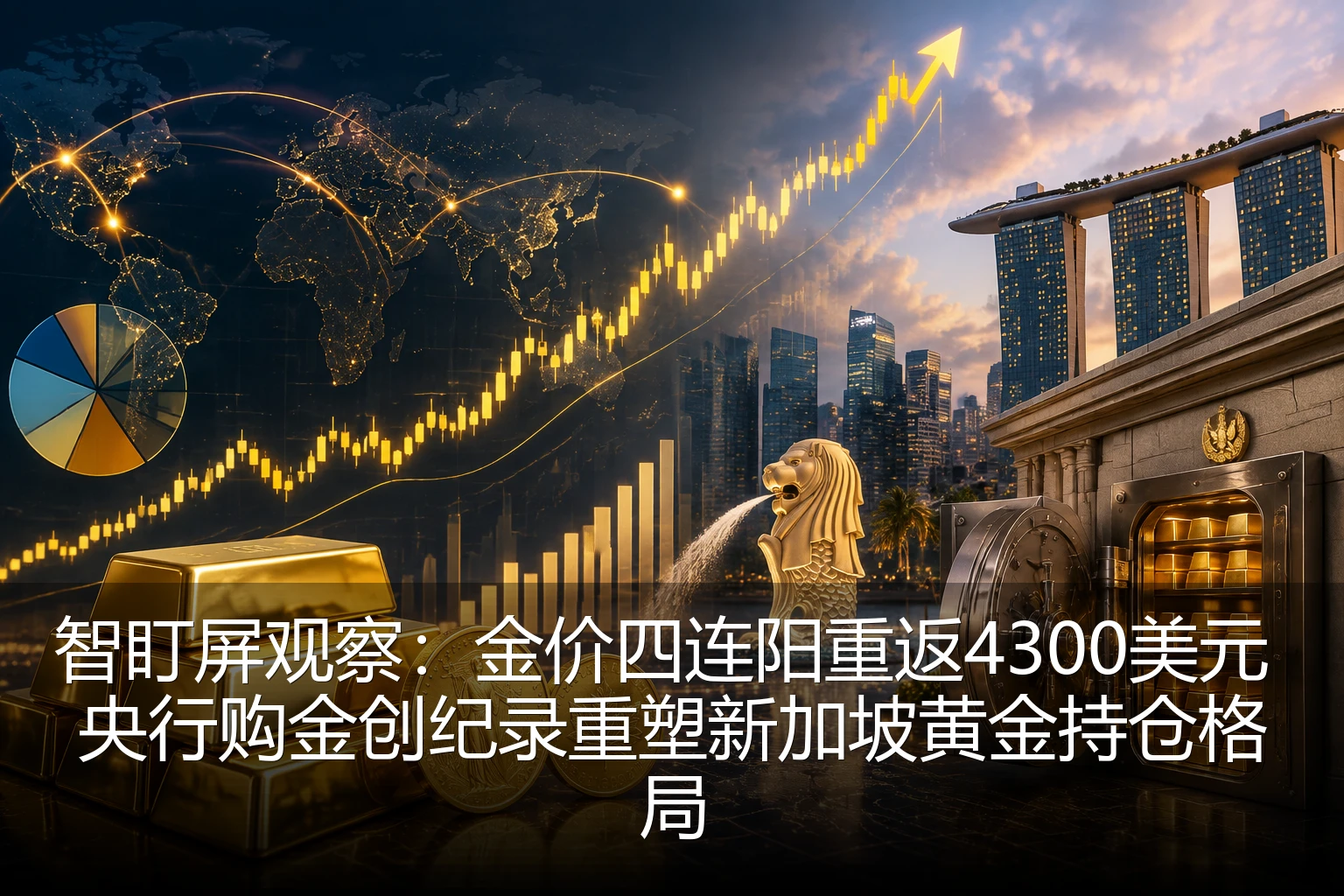
SmartScreen Monitoring: Gold Price Rallies Four Consecutive Days to Reclaim $4300, Central Bank Gold Purchases Set Record, Reshaping Singapore's Gold Holdings Landscape
Singapore Gold Market
Gold Trend Analysis
SGX Precious Metals
Gold Market News Flash
Position Data Insights
Singapore Gold Market Analysis
Precious Metals Holdings Data Analysis
Local Precious Metals Supply & Demand Analysis
The precious metals market in the first week of August is destined to be a memorable event in the trading records of Singaporean traders. After four consecutive days of gains, spot gold briefly broke the $4300 psychological barrier on August 6, reaching a seven-week high since June 18. As of this report, gold prices have stabilized above $4250, showing a cumulative weekly gain of about 4.8%, marking the best single-week performance since January. Meanwhile, silver spot traded around $62, and platinum climbed to the $1755 level, setting a new high since June. The simultaneous strength of gold, silver, and platinum has injected a much-needed bullish sentiment into the local precious metals market in Singapore.
Market Review: The Triple Catalysts Behind Four Consecutive Up Days
The direct trigger for this round of market movements came from employment data across the ocean. The ADP report released July's private sector job additions in the US at only 44,000, far below the market expectation of 70,000, with the increase mainly concentrated in the healthcare sector. This "cold" non-farm payroll report caused market expectations for a Fed rate hike in September to suddenly cool down, with institutional estimates suggesting the probability of a rate hike has dropped to around 54.9%. For gold, which does not generate interest, the decline in rate hike expectations means a reduction in holding costs, thereby repairing its financial attributes.
Employment data surprise: 44,000 ADP job additions in July, far below expectations, reducing the probability of a September rate hike to 54.9%;
Easing geopolitical risks: Iran and Oman nearly reached an agreement on reopening the Strait of Hormuz, and falling oil prices eased inflationary pressures;
Weakening US dollar: The US Dollar Index hovered at a six-week low after joint intervention by the US and Japan, and non-US currencies generally strengthened.
Since the Middle East conflict erupted at the end of February, gold and oil prices have shown a significant "seesaw" effect—as oil prices decline and the US dollar weakens, gold prices gain upward momentum. Under the resonance of multiple factors, gold has experienced a rare run of four consecutive up days, partially recovering from the downturn of the previous six months. However, it is important to note that current gold prices are still down over 20% from the historical peak of $5589 at the end of January, and the market is still observing whether this rebound is a trend reversal or a bounce from oversold conditions.
Central Bank Gold Purchases Set Records: A $288.9$ Ton Safety Cushion
If the short-term market is dominated by macroeconomic expectations, the medium-to-long-term price trend cannot be separated from the role of central banks. The latest Gold Demand Trends Report released by the World Gold Council shows that global central banks net bought 288.9 tons of gold in the second quarter of 2026, a year-on-year increase of 62%, setting a new historical high for the period. Among these, the central bank of China has continuously increased its gold holdings for 20 months, with a quarterly increase of 33 tons in the second quarter, the largest since the fourth quarter of 2023. Central banks in emerging markets, such as Poland, have also maintained a stable pace of gold purchases.
Stable total demand, subtle structural changes It is worth noting that global total gold demand (including OTC transactions) in the second quarter was essentially flat compared to the same period last year at 1,269 tonnes, with cumulative demand in the first half reaching 2,522 tonnes, a year-on-year increase of 2%, and the total value of demand being approximately $380 billion, setting a new high. Industry insiders point out that central bank gold purchases are essentially a strategic choice for diversifying foreign exchange reserves, not driven by speculation, and often involve counter-trend accumulation during gold price pullbacks—this buying power, while not causing sharp spikes, effectively raises the bottom mean of the gold price, providing a solid "safety cushion" for the market, which is a key reason for the resilience of gold prices in a high-interest-rate environment.
Singapore Perspective: Mild Domestic Demand Recovery and Strengthening Hub Status
Shifting the focus to Singapore, data from the World Gold Council shows that gold bar and coin demand in Singapore increased by 6% year-on-year in the second quarter to 2.3 tonnes. Although this growth rate is relatively moderate among the five Southeast Asian countries—Indonesia grew by 40%, Malaysia by 28%, and Thailand by 10%, all leading—Singapore purchased a total of 5.8 tonnes of investment gold in the first half, which is low compared to comparable nations. However, considering the historical baseline of 9.6 tonnes in the same period last year, the mild growth in the domestic retail sector is still noteworthy, indicating the resilience of hedging and diversification needs.
What is more significant is the progress at the infrastructure level. The Monetary Authority of Singapore previously announced that it would provide gold custody services to foreign central banks and sovereign entities starting in October. The Singapore Exchange will also establish an OTC clearing system for physical gold stored locally before the end of the year, with six banks serving as clearing members. Coupled with the commercial storage capacity exceeding 2,000 tonnes in major vaults like FreePort and The Reserve, Singapore's position as a regional gold trading and storage hub is continuously strengthening.
Insight Screen Perspective: How Institutional Funds Respond Amid Market Pulses
Beyond the macro narrative, changes in micro-level holding structures are also interesting. Since the launch of the Singapore Exchange's precious metals holding "Insight Screen" system, institutional holdings have surpassed 70%, significantly improving holding transparency. Observing recent intraday data, the activity of gold-related holdings in the Singapore market noticeably increased after the gold price broke through $4,200, with long-term funds exhibiting a "buy the rally" characteristic. In contrast, the silver market continues the pattern of retail investor retreat followed by institutional takeover, with turnover rates remaining relatively low, suggesting that allocation-oriented funds are trading time for space.
This divergence of "strong gold and stable silver" is essentially a reflection of different fund attributes: the gold side is supported by central bank purchases and ETF inflows, with financial attributes being dominant; the silver side is more supported by industrial demand, with a slower short-term follow-up pace, which in turn leaves room for medium-term positioning. For investors in Singapore, the dynamic changes in holding structures often speak more volumes than the price itself in this critical window before the Non-Farm Payrolls data release.
Outlook: Non-Farm Payrolls Test and ETF Inflows as Key Variables
Looking ahead, the upcoming US Non-Farm Payrolls report is considered the next major turning point. If employment data remains weak, the probability of a September rate hike will be further lowered, and the gold price is expected to challenge the $4,400 region upwards; conversely, if the data is strong, short-term profit-taking pressure may cause the gold price to fluctuate around the $4,250 level. Furthermore, global gold ETFs are gradually turning into net inflows, and if this trend is established, it will form a "dual-engine drive" with central bank purchases, providing support for the medium-to-long-term allocation value of gold. For the Singapore market, the simultaneous advancement of vault expansion, clearing system launch, and position transparency is transforming the role of this Asian financial hub from a "conduit" to a "hub" in the precious metals landscape. Amidst the resonance of macroeconomic expectation reversals and structural capital inflow, understanding positions may be more crucial than guessing the direction.

← Singapore's first domestic physical gold ETF listed for six months: Transparent local vault holdings drive a new ecosystem in the gold market
Zhiding Screen Deep Analysis: August Singapore Precious Metal Holdings Structure Differentiation, Intensified Game Between Institutions and Retail Investors →

