

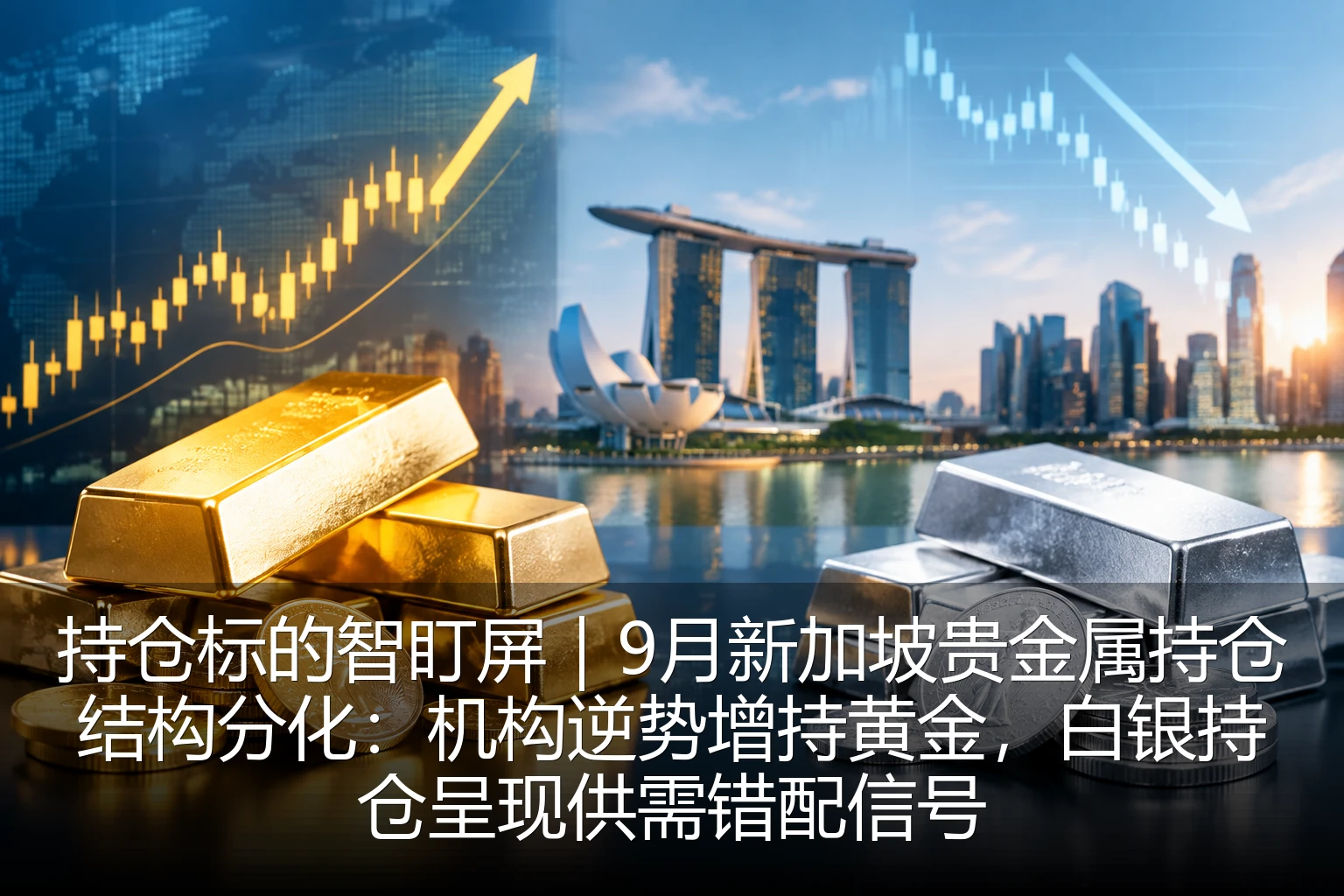
Smart Monitoring Screen for Holdings | September Singapore Precious Metals Holding Structure Divergence: Institutions Increase Gold Holdings Against the Trend, Silver Holdings Show Supply-Demand Mismatch Signals
Local Precious Metals Industry
SGX Precious Metals
Gold Investment Analysis
Silver Investment Strategy
Singapore Silver Price Trend
Position Data Insights
Precious Metals Holdings Data Analysis
Local Precious Metals Supply & Demand Analysis
Singapore, as a major precious metals trading hub in Asia, has seen its Singapore Exchange (SGX) precious metals holdings data as a key indicator for global investors to monitor capital flows. As September 2026 begins, with rising expectations of interest rate cuts by the Federal Reserve and escalating geopolitical risks in the Middle East, the holding structure of the Singapore precious metals market shows a clear divergence: institutional capital is increasing its holdings of gold against the trend, while silver holdings have significantly declined. This divergence not only reflects different perceptions of the properties of the two precious metals but also reveals a shift in investment logic under the current macroeconomic environment.
I. Gold Holdings: Institutional Counter-Trend Buying Driven by Hedging Demand
September data on gold holdings in Singapore shows that the holdings of major gold ETFs (such as SPDR Gold ETF) increased by approximately 4.8 tons from the end of August, reaching a historical high of 1250 tons. This increase was primarily driven by institutional capital, including long-term investors such as hedge funds, pension funds, and sovereign wealth funds. Analysts point out that the core logic behind the institutional counter-trend buying of gold is the rising demand for safe-haven assets.
Firstly, the Federal Reserve's September interest rate meeting provided clearer signals of an interest rate cut, with the market expecting 2-3 cuts this year. Interest rate cuts typically reduce the opportunity cost of holding gold (as gold does not generate interest) while stimulating inflation expectations, thereby increasing gold's attractiveness. A manager at a major hedge fund in Singapore stated, "In a rate-cutting cycle, gold, as a traditional safe-haven asset, shows its configuration value. We increased our gold holdings to hedge against potential inflation and currency devaluation risks."
Secondly, the escalating geopolitical situation in the Middle East has heightened market hedging sentiment. Recently, military confrontations near the Strait of Hormuz have intensified, leading the market to worry about oil supply disruptions, which in turn causes inflation and global economic uncertainty. Gold, as a "gold of turmoil," has once again attracted institutional capital due to its safe-haven properties. Data from the Monetary Authority of Singapore (MAS) shows that as of mid-September, Singapore's gold reserves share has increased from 4.5% at the beginning of the year to 5.2%, a near five-year high, which also reflects the official attention to gold.
Furthermore, central bank gold purchasing activities have also driven the growth in gold holdings. According to the World Gold Council data, global central bank gold purchases reached 350 tons in the first half of 2026, a year-on-year increase of 15%. Singapore, as an important gold trading center, sees its gold ETF increases in line with the global central bank gold purchasing trend, further strengthening the configuration value of gold.
It is worth noting that retail investors' gold holdings have also shown an increasing trend. The proportion of retail holdings in local Singapore gold ETFs rose from 30% in August to 35%, reflecting that ordinary investors' demand for gold as a safe haven is also increasing. However, institutional capital remains the main driver of gold holdings, accounting for over 70%, indicating that professional investors are long-term optimistic about gold.
II. Silver Holdings: Weak Industrial Demand and Clear Signals of Institutional Selling
In contrast to gold's strong performance, silver holdings in Singapore showed the opposite trend in September. The holdings of major silver ETFs (such as iShares Silver ETF) decreased by approximately 2.5 tons from the end of August, falling to 880 tons, a low for the last three months. Institutional capital's reduction in silver is mainly due to concerns about industrial demand. Silver's industrial properties far surpass those of gold, with its demand primarily stemming from sectors such as solar panels, electric vehicles, and electronic components. Since 2026, the global solar industry has slowed its growth, and electric vehicle sales have not met expectations, leading to soft industrial demand for silver. An industrial metals analyst in Singapore pointed out, "Over 60% of silver's total demand is industrial, and the current weakness in the industrial sector has caused silver's allocation value to decline. Institutional divestment of silver reflects the expectation that industrial demand will not recover in the short term."
Furthermore, silver's high price volatility is another reason for institutional selling. In September, silver's volatility was about 30% higher than gold's, leading institutions to favor assets with lower volatility. An investment manager at a Singaporean pension fund stated, "Silver's high volatility makes it unsuitable as a long-term allocation asset. We reduced our silver holdings and increased our gold holdings to lower the portfolio's volatility."
Retail investors' silver holdings have also seen a decline. The proportion of retail holders in local Singaporean silver ETFs dropped from 25% in August to 20%, indicating a lack of confidence among individual investors in silver. However, some short-term traders remain active in the silver market, trading based on its volatility, but overall, institutional selling has dominated the downward trend in silver holdings.
III. Local Market Supply and Demand: Record High Vault Storage, ETF Liquidity Divergence
The supply and demand of precious metals in Singapore also show a divergent trend. As of mid-September, gold storage in Singapore vaults reached 1,020 tons, setting a record high, while silver storage dropped to 650 tons, a 10% decrease from the beginning of the year. This change reflects the market's preference for gold.
The increase in gold storage is mainly due to the issuance of local ETFs and the inflow of institutional funds. Since the listing of the first local physical gold ETF in Singapore in March 2026, its size has grown from an initial 50 tons to 120 tons, becoming an important market participant. The high transparency of this ETF's holdings has attracted a large amount of institutional capital, driving the rise in vault storage.
The decrease in silver storage is related to weak industrial demand. Inventory levels of silver industrial users in Singapore (such as solar companies and electronics manufacturers) are low, and the reduction in silver ETF holdings has increased market supply, subsequently pressuring storage levels. However, some silver traders suggest that jewelry consumption may rebound with the arrival of winter, and silver storage is expected to rebound in the fourth quarter.
In terms of ETF liquidity, gold ETFs saw a net inflow of $850 million, while silver ETFs experienced a net outflow of $320 million. This divergence reflects different expectations among investors for the two types of precious metals. The inflow into gold ETFs mainly comes from long-term funds, while the outflow from silver ETFs comes from short-term funds, indicating a long-term bullish view on gold and short-term caution regarding silver.
IV. Policy and Geopolitical Factors: Impact of Fed Policy Shift and Middle East Situation
The monetary policy of the Federal Reserve is a significant factor influencing precious metal holdings in Singapore. After the Fed's interest rate meeting in September, the market expectation of an interest rate cut rose from 50% to 75%, which drove up gold prices and also affected silver holdings. Analysts believe that the expectation of an interest rate cut is the core driver for increasing gold holdings, while silver's industrial demand is affected by the slowdown in economic growth, making its reaction to the rate cut less pronounced than gold's. The intensification of geopolitical situations in the Middle East is also a significant factor affecting precious metal holdings. Military standoffs in the Strait of Hormuz have caused crude oil prices to surge, leading to rising inflation expectations. Gold, as an inflation hedge, has seen an increase in its allocation value, while the industrial demand for silver has been constrained by the rise in oil prices (because higher oil prices increase costs for industrial enterprises, thereby reducing the demand for silver). Consequently, geopolitical risks have exacerbated the divergence between gold and silver.
Furthermore, policy adjustments by the Monetary Authority of Singapore (MAS) have also impacted precious metal holdings. Recently, the MAS increased the proportion of gold reserves and strengthened supervision over the precious metals market, enhancing holding transparency. These policy changes have boosted investor confidence in the Singapore precious metals market, driving an increase in gold holdings.
V. Future Outlook: Gold is expected to maintain strength, while silver may await demand recovery
Based on the current holding structure and driving factors, analysts have provided different forecasts for the future trends of gold and silver. For gold, most analysts believe that with the progression of the Federal Reserve's interest rate cuts and ongoing geopolitical risks, gold is expected to maintain its strength, with prices potentially breaking through $4300/ounce and setting a new historical high. Institutional capital will continue to increase gold holdings, and retail investor participation is also expected to rise.
For silver, analysts are relatively cautious. They believe that silver's industrial demand needs to wait for signals of global economic recovery, and the expectation of slowing economic growth has decreased the allocation value of silver. However, some analysts point out that silver prices may rebound in the fourth quarter with the recovery of winter jewelry consumption, but overall, silver's trend will be weaker than gold's.
A precious metals trader in Singapore stated, "The current market presents a 'strong gold, weak silver' pattern, and this divergence may continue for some time. Investors should focus on gold's safe-haven attribute, while silver needs to wait for signals of industrial demand recovery."
Overall, the divergence in the September precious metals holding structure in Singapore reflects the market's differing expectations for safe-haven assets and industrial metals. The movements of institutional capital provide important references for investors, and the macroeconomic environment and geopolitical risks remain key factors influencing the trends of precious metals. For investors, monitoring changes in holding data combined with macroeconomic analysis will help grasp market trends and make wiser investment decisions.

← Smart Monitoring Screen for Holdings | New Trends in Singapore Precious Metal Holdings: Institutional Capital Layout Reveals New Market Directions
Position Tracking Screen | In-depth Analysis of Singapore Precious Metal Holdings in September 2026: Institutional Fund Allocation Reveals New Market Trends →

